Intumescent Coating for Steel in Dubai
Benefits Of Using Intumescent Paint For Fire Protection
Fireproofing with fire resistant paints, a.k.a. intumescent coating, solves a variety of problems that you may not consider until an issue arises. For example, many facility owners are unaware of the importance of protecting something as critical to the integrity of their building as steel beams, which are already considered fireproof.
Structural steel loses roughly half of its strength at around 550 to 600 degrees Celsius, and building fires can exceed those temperatures, so maintaining structural rigidity and tensile strength is a serious problem, and collapse can result.
Finally, staying up to date on code is critical when running a commercial facility to avoid serious liability issues. If there are any code violations, you will face a lot of wasted money in fines. You can be confident that your business will remain operational, clean, safe, and maintained while working with an expert professional in intumescent fireproofing.
Evora is approved by Dubai Civil Defence and Abu Dhabi Civil Defence.

Intumescent coating is a popular method of providing passive fire protection to load-bearing materials, particularly structural steel, in current architectural design for industrial and commercial buildings. In terms of fire protection, intumescent coating has various advantages:
- It does not affect the intrinsic qualities of materials, such as their mechanical properties.
- It can safeguard your steel frame for up to 120 minutes.
- Intumescent paints can be applied to various materials, including steel, wood, composite parts, and concrete
How Does Intumescent Fireproofing Work?
When a fire or excessive heat develops, the intumescent paint activates. If heat is generated, a chemical reaction in the coating causes it to form a foam of non-flammable gasses such as ammonia or carbon dioxide, resulting in an insulating layer on the coating.
These layers react by absorbing heat and producing a layer of char up to 50 times the thickness of the coating. This slows the spread of the fire and protects the structure’s strength from failure for an extended length of time, potentially saving both lives and the structure itself.
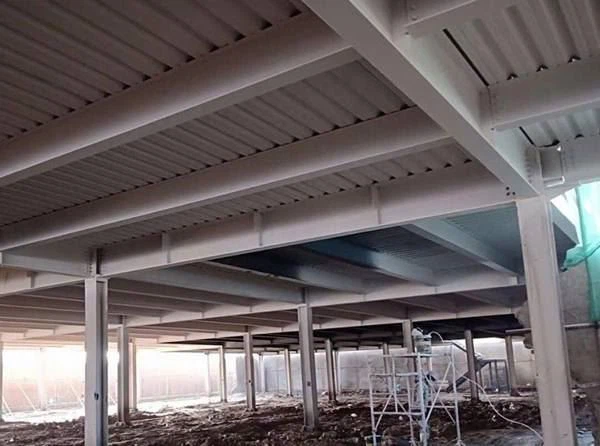
The most common substrate for intumescent coatings is steel, but they can also be found on wood, concrete, and other materials. Intumescent paint for steel, for example, is used on steel beams, columns, and supports in residential and commercial buildings to protect while also adding aesthetic value.
Intumescent coatings are typically classified as industrial coatings. Pipelines are one such application. As fluids are pumped through quickly, friction increases, resulting in rising heat. The same applies to oil and gas rigs.
All that being said, one negative aspect of intumescent paint is that it is difficult to apply. Proper application is critical to the performance of a fire-resistant coating for steel. To obtain the required fire rating, specific suitable, manufacturer-designated primers must be used, as well as numerous coats. Improper application of intumescent coating on steel might result in calamities. For this reason, you should always hire experienced contractors and source materials from only the best. This is where we at Evora come into play.
The Different Types Of Intumescent Fireproofing & What It Includes
The intumescent coating varies in composition and application across sectors.
- Water-based Intumescents: It is more environmentally friendly and has less odor. While inexpensive, they may take longer to cure in high humidity or cold conditions, making them ideal for interior applications where curing time is not crucial.
- Solvent-based Intumescent: Solvent-based coatings are weather and temperature-resistant, drying swiftly and leaving a smooth finish. They are frequently utilized in semi-exposed areas where toughness and quick drying are required.
Epoxy-based Intumescent: Epoxy-based formulations perform well in tough environments such as offshore marine or chemical industries, providing superior hydrocarbon fire protection and corrosion resistance. They are often coated in two portions to create a thick, durable layer that effectively insulates steel members.
Some of the key ingredients of intumescent paint include the following.
- Ammonium Polyphosphate: Ammonium polyphosphate degrades into ammonia and polyphosphoric acid at high temperatures.
- Melamine: Melamine decomposes into ammonia, carbon dioxide, and water at temperatures above 340°F.
- Pentaerythritol: Pentaerythritol has a lower temperature threshold than melamine, decomposing into aldehydes at 190°F.
- Titanium Dioxide: This is unexpected, as titanium dioxide, or TiO2, is best recognized as a white pigment. At normal temperatures, TiO2 is chemically inert. Rutile TiO2 melts at temperatures exceeding 1800°F and binds with polyphosphate.
Carboline intumescent coatings we use
The thin-film intumescent systems we apply to structural steel. The right product depends on the fire rating, where the steel is, and the conditions on site. Our team will confirm the system for your project.
| Product | Type | Fire resistance | Where it is used | Notes |
|---|---|---|---|---|
| SC801 | Water-based | Up to 120 minutes | Interior structural steel | White thin film, smooth matt finish, low odour |
| SC802 | Water-based, single pack | Up to 60 minutes | Interior steel; semi-exposed with a topcoat | Easy to spray on site, smooth matt finish |
| SC803 | Water-based | Up to 60 minutes (limited 90 minutes) | Interior structural steel | Ultra-low VOC, compatible with a wide range of primers and topcoats |
| SC804 | Water-based | Up to 120 minutes | Interior structural steel | Ultra-low VOC, good appearance |
| SC902 | Hybrid, high-build | Up to 120 minutes | Interior, semi-exposed and exterior (with an approved top seal) | On-site and off-site, one-coat system, tested to BS 476 and EN 13381-8 |
Product information is taken from the manufacturer's published data and is for general reference. Ratings depend on the steel section, thickness and system, so always follow the current data sheet and the project specification. Call or WhatsApp +971 52 6700 119.
Hempel intumescent coatings
The Hempacore and Hempafire ranges for structural steel, for projects that call for a Hempel system.
| Product | Type | Fire resistance | Where it is used | Notes |
|---|---|---|---|---|
| Hempacore One | One-component, solvent-borne acrylic | Up to 120 minutes (cellulosic fire) | Structural steel in buildings such as industrial halls, public buildings, stadiums and airports | On-site and off-site application |
| Hempacore One FD | One-component, solvent-borne, fast-drying | Up to 120 minutes (cellulosic fire) | Interior and exterior structural steel; beams, columns, hollow sections and cellular beams | Applied in the shop or on site; Type X under EAD 350402-00-1106 / EN 16623; corrosivity category C4; up to 1100 microns dry per coat; also used for repair and touch-up |
| Hempacore AQ | Waterborne, VOC-free | Range offered for 30, 60, 90 or 120 minutes | Structural steel (cellulosic fire) | Meets current green-building environmental standards |
| Hempafire Pro 315 and Pro 315 Fast Dry | One-component, solvent-borne, physically drying (Pro 315) | Optimized for 30 and 60 minutes; 90 minutes may be possible depending on the project | Structural steel: I-section beams, H columns, hollow sections and cellular beams; interior and exterior | Shop or site application; Type X and corrosivity category C4; also used for repair and touch-up |
| Hempafire Pro 320 | Thin-film intumescent | Tested up to 90 minutes (cellulosic fire) | Structural steel: I-section beams, hollow sections and cellular beams | Applied in the shop or on site |
| Hempafire Pro 400 | One-component, solvent-borne, physically drying | Optimized for 90 and 120 minutes (tested up to 120 minutes) | Structural steel: I-section beams, H columns, hollow sections and cellular beams; interior and exterior | Shop or site application; Type X and corrosivity category C4; also used for repair and touch-up |
| Hempafire Optima 500 | One-component waterborne acrylic thin film, very low VOC | Optimized for 120 minutes on site; 180 minutes may be possible depending on the project | Structural steel (cellulosic fire) | Internal environments |
| Hempafire Optima 510 | One-component waterborne acrylic thin film, very low VOC | Optimized for 120 minutes on site; 180 minutes may be possible depending on the project | Structural steel, high Hp/A open sections | Internal environments up to C3 |
| Hempafire Optima 515 | One-component waterborne acrylic thin film, very low VOC | Optimized for 120 minutes on site on open sections | Structural steel: I-section beams and H columns | Internal environments up to C3 |
| Hempafire Extreme 550 | Two-component, solvent-free epoxy, chemically curing | Optimized for 30 to 120 minutes; 180 and 240 minutes may be possible depending on the project | Structural steel: I-section beams, H columns, hollow sections and cellular beams; interior and exterior | Optimized for shop application; on-site possible depending on equipment; Type X and C5 |
Product information is taken from the manufacturer's published data and is for general reference. Ratings depend on the steel section, thickness and system, so always follow the current data sheet and the project specification. Call or WhatsApp +971 52 6700 119.
Frequently Asked Questions
What does an intumescent coating do?
How long do intumescent coatings last?
What material is intumescent?
Intumescent Paint for Steel in Dubai and the UAE
Intumescent paint is a thin fireproof coating for structural steel. When the steel heats up in a fire, the coating swells into a thick, insulating char. The char slows the rise in steel temperature, so the steel keeps its load-bearing strength for the fire rating the building needs. Evora applies intumescent coating in Dubai, Abu Dhabi and across the UAE.
Where intumescent coating is used
- Exposed structural steel beams and columns in commercial and industrial buildings
- Steel in warehouses, plant rooms, car parks and retail buildings
- Steel frames where the architect wants a smooth, paint-like finish instead of a thick sprayed layer
Intumescent paint or cementitious fireproofing?
Intumescent paint gives a thin, neat finish and suits steel that stays visible. Cementitious fireproofing is a thicker spray-applied layer, often used where the steel is hidden. Which one fits depends on the fire rating, the steel section and the finish you need. We recommend a system after reviewing your project.
What affects the intumescent coating you need
- The fire rating required, commonly expressed in minutes of resistance
- The steel section size and the loading
- Indoor or outdoor exposure
- The finish and colour required
Intumescent coating applied by Evora
We prepare the steel surface, apply the system to the thickness it requires and check the finished coating. Evora is approved by Dubai Civil Defence and Abu Dhabi Civil Defence. Read our intumescent coating FAQs, see all fire proofing services or request a quote. Call or WhatsApp +971 52 6700 119.
Looking for protection for beams and columns? See our page on fire proofing for steel structures, or compare with cementitious fireproofing.
Related guides
- What is intumescent paint?
- Intumescent coating in Dubai: types, thickness and fire ratings
- Intumescent paint for steel in the UAE
- Intumescent vs cementitious fireproofing
Intumescent paint FAQ
What is intumescent paint?
Intumescent paint is a thin coating that swells into a thick insulating char when it is heated, slowing the rise in steel temperature during a fire.
Where is intumescent paint used?
It is mainly used on exposed structural steel such as beams and columns, where a neat paint-like finish is wanted.
What is the difference between intumescent paint and cementitious coating?
Intumescent paint is thin and suits exposed steel. Cementitious coating is a thicker cement-based spray that usually suits concealed steel and concrete.
Which intumescent products does Evora use?
Evora uses Carboline intumescent coatings (SC801 to SC804 and SC902) and Hempel Hempafire coatings. The product tables on this page list them.
Evora is approved by Dubai Civil Defence and Abu Dhabi Civil Defence and works across the UAE. Call or WhatsApp +971 52 6700 119.
When to choose intumescent paint
Intumescent paint is the usual choice for exposed structural steel where a slim finish is wanted. It stays thin in normal conditions and swells into an insulating layer when heated. Where a thicker protective layer is acceptable, compare it with cementitious coating. For the wider picture, see fire proofing and passive fire protection.
The product, thickness and rating depend on the steel section and the fire rating required. Evora works with Dubai Civil Defence and Abu Dhabi Civil Defence approval. Call +971 52 6700 119 with your drawings or project details.